
Radiator Repair and Replacement in
Bristol, PA
LOCALLY OWNED | OEM CERTIFIED | FAST TURNAROUNDS
SERVICES
Losing Coolant or Running Hot? Start With the Radiator
A puddle of orange coolant appears under the front bumper every morning, the temperature gauge creeps up in traffic, and the reservoir is empty again a week after it was filled. Drivers in Bristol, PA bring these complaints to VIP Service Center when they search for radiator repair near me. Our ASE-certified technicians pressure test the system, locate the exact point where the radiator leaks, and repair or replace it with warranty-backed work and a written estimate approved before the job starts.
Radiators in Bucks County work hard in every season. Road salt from the winter months eats at the aluminum fins and the crimped seams of the plastic tanks, and summer stop-and-go traffic on Route 13 and I-95 keeps the coolant at its hottest for long stretches. That is why a radiator that has been seeping quietly for weeks often gives out during the first heat wave of summer or the first hard freeze of winter.
Book this service at VIP Service Center, 4030 New Falls Rd, Bristol, PA.
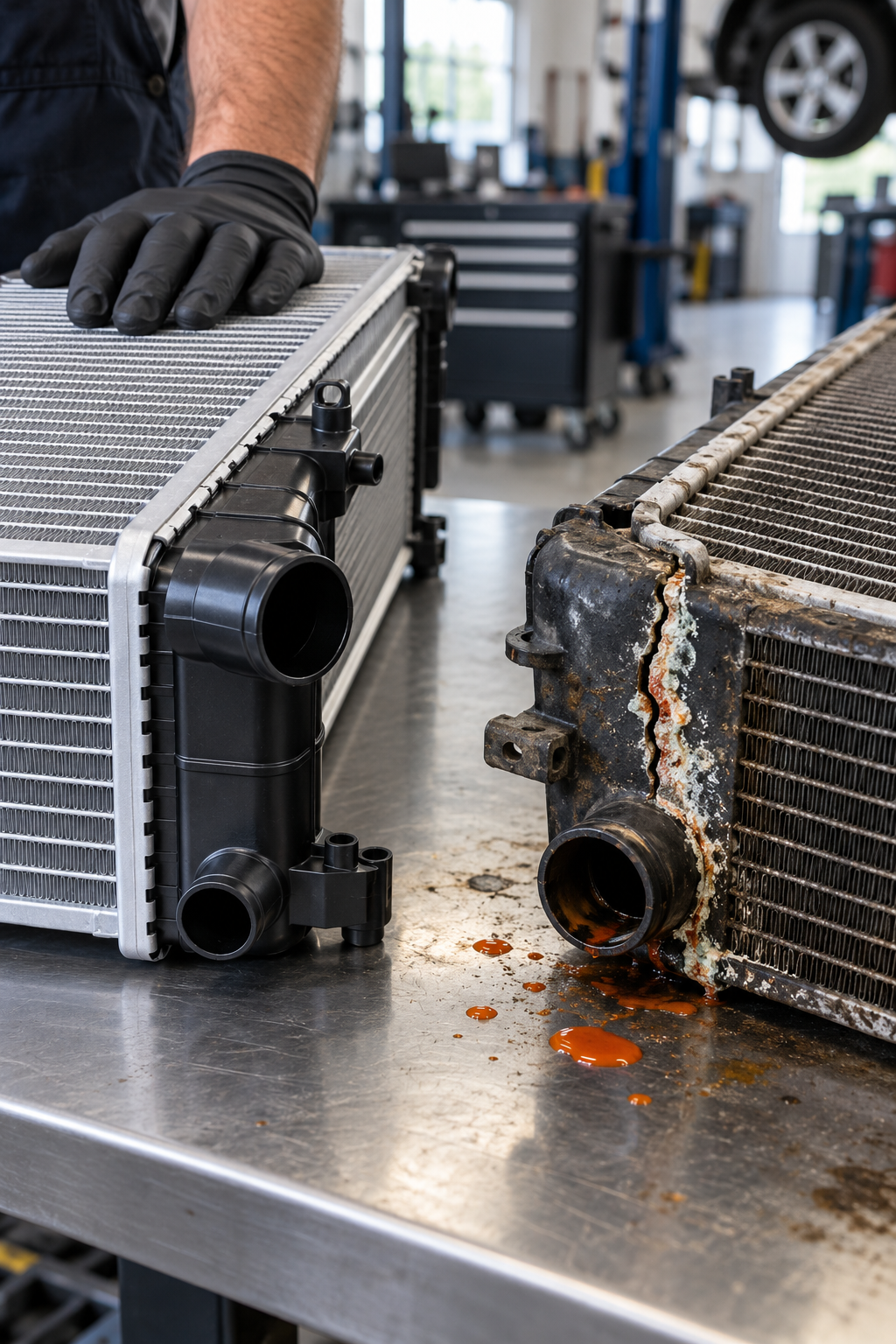
Radiator Repair Services in Bristol, PA
VIP Service Center handles radiator work in Bristol, PA from a worn pressure cap to a complete radiator replacement with new hoses and fresh coolant. Each job starts with a pressure test that pins the leak to the radiator, a hose, the cap, or a different part of the cooling system, and the written estimate covers only what the test found.
Radiator repair services at VIP Service Center include:
- Radiator pressure test and leak location
- Radiator replacement with a new unit matched to the vehicle
- Radiator hose replacement, upper and lower
- Radiator cap replacement and pressure rating check
- Radiator fan and fan shroud repair
- Transmission cooler line inspection on radiators with a built-in cooler
- Coolant refill, air bleed, and second pressure test after the repair
We service domestic, Asian, and European vehicles, and our ASE-certified technicians back the work with a warranty.
Radiator Designs on Every Make and Model
We repair and replace radiators on cars, SUVs, and light trucks at our Bristol, PA shop. Radiator design has changed over the decades, and the design decides whether a leak can be repaired or the radiator must be replaced.
A radiator moves heat from the coolant to the air. Hot coolant enters the inlet tank, flows through dozens of thin tubes bonded to cooling fins, gives up its heat to the air pulled through by the fan, and leaves through the outlet tank back to the engine.
Most vehicles built in the last thirty years use an aluminum core with plastic end tanks held on by a crimped metal lip and a rubber gasket. Older trucks and classic cars use a brass or copper radiator with soldered tanks. The aluminum and plastic design is lighter and cheaper to build, and it fails at the crimp seam and in the plastic tanks, where the brass design fails at the solder joints and in the core.
Many automatic transmission vehicles also route transmission fluid through a cooler built into one radiator tank. A crack between the two chambers mixes coolant and transmission fluid, which damages the transmission within a short time.
Signs Your Radiator Needs Repair
A radiator is failing when one or more of the following signs appear. Each points to a leak, a blockage, or a tank that has lost its seal.
- Leak signs include a puddle of green, orange, or pink coolant under the front of the vehicle, a white or colored crust along the top or bottom tank seam, and a wet area on the core itself after a drive.
- Temperature signs include a gauge that runs hotter than its usual position, an overheat in traffic that settles at highway speed, and a heater that blows cool air while the engine is hot.
- Fluid signs include a reservoir that needs topping off between oil changes, coolant that looks rusty or has oil floating on it, and a milky or pink tint in the transmission fluid, which points to an internal cooler leak.
- Physical signs include bent or crushed fins across a section of the core, a plastic tank that has turned brown or brittle, and a bulge in the tank near the inlet or outlet.
When any of these signs appear, our technicians in Bristol, PA can pressure test the system and confirm whether the radiator, a hose, or the cap is the source before the engine overheats.
What Causes Radiator Leaks and Failure
Radiators fail from four causes: age and heat cycling, corrosion, physical damage, and pressure beyond the design limit.
Heat cycling works on the plastic tanks. Every drive heats the tank and every shutdown cools it, and after years of expansion and contraction the plastic turns brittle and cracks, usually near the inlet neck or along the crimp seam where the tank meets the core.
Corrosion works from the inside when coolant stays in service past its interval. The inhibitors wear out, the aluminum tubes pit, and scale narrows the passages until a section of the core stops flowing. Electrolysis, caused by a poor engine ground, speeds the same process.
Physical damage comes from road debris that punctures the core, a front-end collision that bends the tanks, and a fan blade or shroud that has come loose and rubs the fins.
Overpressure comes from a failed pressure cap that no longer vents, a head gasket leak that pushes combustion gas into the coolant, or a blocked passage that lets pressure build in one tank. Any of these splits a plastic tank that would otherwise have lasted years longer.
How We Find a Radiator Leak in Bristol, PA
Coolant on the ground under the radiator does not prove the radiator is the leak, since fluid from a hose, the water pump, or the thermostat housing runs down and drips from the lowest point. The diagnosis locates the actual source before any part is replaced.
- We start with a pressure test on the cold system. A hand pump raises the pressure to the rating on the cap, and we trace the radiator tanks, seams, core, hose ends, and cap seat with a light while the gauge shows whether pressure holds.
- For leaks too small to see, we add ultraviolet dye to the coolant, run the engine to temperature, and inspect with a UV lamp. The dye glows at the exact point of the leak, including seam cracks that only open when the tank is hot.
- We test the cap separately on a cap adapter, since a cap that releases below its rating pushes coolant out of the overflow and mimics a radiator leak.
- We also check the transmission fluid for coolant contamination and the coolant for transmission fluid, which identifies an internal cooler failure.
The result goes into the written estimate before any work begins at our Bristol, PA shop.
Radiator Leak Repair or Radiator Replacement in Bristol, PA
Whether a radiator is repaired or replaced depends on its construction and on where it leaks. Most leaks on modern aluminum and plastic radiators end in replacement, since the materials cannot be soldered and the crimp seam cannot be resealed once it has opened.
Repair applies to brass or copper radiators, where a cracked seam or a leaking tube can be cleaned and soldered, and to a small number of aluminum cores where a single tube can be isolated. It also applies when the leak turns out to be the hose, clamp, or cap and the radiator itself holds pressure.
Replacement applies when a plastic tank has cracked, when the crimp seam weeps, when the core is corroded through, when the fins are crushed across a large area, or when the internal transmission cooler has failed. We install a new radiator matched to the vehicle’s engine, transmission type, and cooling capacity.
Stop-leak additives and epoxy patches are not part of our repair process. The additive circulates through the heater core and the engine passages and blocks them along with the leak, and a patch on a plastic tank reopens under the next heat cycle.
The replacement process our technicians follow includes:
- Draining the coolant and disconnecting the upper and lower hoses, the overflow line, and the transmission cooler lines where fitted.
- Removing the fan shroud, the electric fan, and any air conditioning condenser brackets that share the radiator mounts.
- Lifting out the old radiator and inspecting the mounts, the condenser, and the hoses for damage.
- Installing the new radiator with new rubber mounts, reconnecting the hoses with new clamps, and reconnecting the cooler lines.
- Refilling with the manufacturer-specified coolant, bleeding the air from the high points, and running the engine to temperature with the fan cycling.
- Pressure testing the complete system and checking the transmission fluid level where cooler lines were opened.
Can You Drive With a Leaking Radiator
A slow seep from a radiator seam can be driven for a short time with the coolant level checked before every drive, but the leak only grows. Plastic tanks crack further with each heat cycle, and a seam that weeps in the morning can open fully on the highway.
Once the coolant drops below the level of the upper hose, the engine runs hot within minutes. An overheat long enough to move the gauge into the red can warp the aluminum cylinder head and turn a radiator replacement into a head gasket repair.
When steam appears or the gauge enters the red, the safe step is to pull over, shut the engine off, and have the vehicle towed. Topping off a hot radiator by opening the cap releases pressurized steam and scalds hands and face, so the cap stays closed until the engine has cooled.
SERVICES
-
Alignment Service
Proper wheel alignment ensures even tire wear, better fuel efficiency, and improved handling. Our precision alignment service keeps your vehicle driving smoothly and safely.
Visit Page -
Transmission Service
A well-maintained transmission prevents costly breakdowns and ensures smooth gear shifts. Our expert service includes fluid changes, diagnostics, and repairs for optimal performance.
Visit Page -
Exhaust Services
Your exhaust system reduces emissions, enhances engine efficiency, and ensures a quieter ride. We repair leaks, replace worn components, and optimize performance for cleaner operation.
Visit Page
OUR LOCATION
Exceptional Auto Repair and Maintenance in Bristol, PA and Nearby Areas
Located in Bristol, PA, VIP Service Center is your trusted destination for professional auto repair and maintenance services. Our shop is committed to delivering top-quality repairs, routine maintenance, and advanced diagnostics to keep your vehicle running at its best. With a team of ASE-certified technicians, we specialize in servicing a wide range of vehicles, ensuring precise and efficient workmanship.
Our central location allows us to conveniently serve Bristol and the surrounding communities, making expert auto care easily accessible for local drivers. Whether you need a wheel alignment, transmission service, or an ADAS calibration, we are here to help. Our customer-first approach and industry expertise make us the go-to auto repair shop in the region.
- Bensalem
- Levittown
- Croydon
- Fairless Hills
- Fairless Hills
- Langhorne
- Tullytown
- Morrisville
- Hulmeville
- Penndel
- Andalusia
- Feasterville
- Trevose
- Newportville
- Eddington
- Fallsington
FAQ
Can a radiator leak be repaired, or does the radiator need to be replaced?
Brass and copper radiators can usually be soldered. Aluminum radiators with plastic tanks, which most vehicles built since the 1990s use, are replaced once the tank or the crimp seam leaks, since the materials cannot be resealed in a way that survives heat cycling.
How do I know if it is the radiator or a hose?
A hose leak shows wet rubber at the hose end or a split along the hose body, and the hose feels soft or swollen. A radiator leak shows a crust or wet spot on the tank seam or the core itself. A pressure test with dye confirms the source when the two are close together.
Does radiator stop-leak work?
Stop-leak additives seal small pinholes for a short time, but they also coat the heater core, the thermostat, and the narrow engine passages, and they often cause a blockage that costs more to fix than the original leak. We flush the system and repair the leak at its source.
How long does radiator replacement take?
Most radiator replacements take two to four hours. The time depends on how much of the front end must be removed to lift the radiator out, whether the vehicle has transmission cooler lines, and whether the fan and shroud are separate or built into the radiator assembly.
Should I replace the hoses when the radiator is replaced?
Yes, when the hoses show the same age as the radiator. Old hoses harden at the ends and seal poorly on a new radiator neck, and replacing them during the same job avoids a second drain and refill later.
What affects the cost of radiator repair in Bristol, PA?
The main factors are whether the fix is a hose, a cap, or a full radiator, the radiator’s size and whether it includes a transmission cooler, how much of the front end must be removed for access, and the type and volume of coolant the vehicle requires. We provide a written estimate after the pressure test and before any work begins.
VEHICLES
At VIP Service Center, we proudly service a wide range of vehicles, including domestic, European, and Asian makes and models. Whether you drive a luxury sedan, rugged SUV, powerful truck, or fuel-efficient compact car, our ASE-certified technicians have the expertise to handle all your maintenance and repair needs. We work on top brands like Audi, BMW, Chevrolet, Ford, Honda, Toyota, Mercedes-Benz, Jeep, Nissan, and more, ensuring high-quality service with manufacturer-approved parts and advanced diagnostic tools. No matter your vehicle type, you can trust VIP Service Center for precision repairs, expert maintenance, and reliable performance to keep you on the road safely.
-
View Acura Page
-
View Audi Page

-
View BMW Page

-
View Buick Page

-
View Cadillac Page
-
View Chevrolet Page

-
View Chrysler Page
-
View Dodge Page
-
View Fiat Page
-
View Ford Page

-
View GMC Page
-
View GM Page

-
View Honda Page
-
View Hummer Page
-
View Hyundai Page

-
View Infiniti Page
-
View Isuzu Page

-
View Jaguar Page

-
View Jeep Page
-
View Kia Page

-
View Land Rover Page

-
View Lexus Page
-
View Lincoln Page
-
View Mazda Page
-
View Mercedes-Benz Page

-
View Mercury Page
-
View Mini Page

-
View Mitsubishi Page

-
View Nissan Page
-
View Plymouth Page
-
View Pontiac Page
-
View Porsche Page
-
View Saab Page
-
View Saturn Page
-
View Scion Page
-
View Smart Page
-
View Subaru Page
-
View Suzuki Page

-
View Toyota Page

-
View Volkswagen Page

-
View Volvo Page

Get a Quote for Auto Repair
Your request has been sent!
We will get back to you as soon as possible.